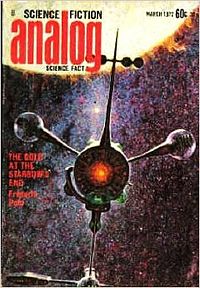
The Gold at the Starbows End
by Frederik Pohl
The story is told with two narrative devices—reports from members of the crew of the U.S. Starship Constitution alternating with a traditional third-person narration of the activities back on Earth. The main protagonist of the activities on Earth is Dr. Dieter von Knefhausen, the scientist in charge of the U.S. space program.
In the first report from the starship, the reader learns that the ship is approximately one month into a multi-year journey to the Alpha Centauri star system, where the crew will begin colonization of the planet Alpha-Aleph. Already, the crew is finding they have too much free time and have begun filling that time by studying various problems in mathematics. In the first narration of the action on Earth, the reader learns that society has become dystopian. The possibility of colonizing Alpha-Aleph is a source of hope for a better future.
As the story progresses, the reader is told that the existence of the planet Alpha-Aleph is a hoax, perpetrated not only on the American people but also on the crew of the starship. The true purpose of the mission is to place the crew in a position where they will have nothing to do other than study mathematics. The hoax was the idea of Knefhausen, who believes that, if deprived of any other means of recreation, the crew will succeed in making scientific breakthroughs that will then be broadcast back to Earth. Knefhausen's theory proves true, but he learns that the crew quickly becomes bored with technological applications of their new-found mathematical prowess. Instead, they become increasingly interested in using it to develop their understanding of art and philosophy. These new understandings give the crew an unusual control over the physical universe and, by the end of the story, they have achieved god-like powers.
Two recurring mathematical themes in the story are Carnap-Ramsey sentences
The word "starbow" in the story's title is a word coined by one of the characters on the starship. It refers to the rainbow-like effect seen when stars are undergoing a relativistic Doppler effect.