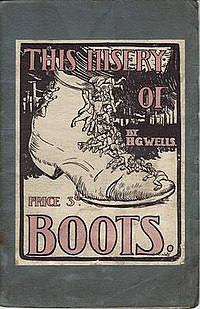
This Misery of Boots
by H. G. Wells
Chapter 1: The World as Boots and Superstructure
Wells's point of departure is a reminiscence of a conversation with "a realistic novelist . . . a man from whom hope had departed." An encounter with a limping tramp spurs a discussion of the 10–20% of the British population that suffers from "this misery of the boot." They classify the various sources of discomfort (bad material, bad fit, bad condition, various sorts of chafe, the wear of the sole, splitting and leaks, etc.) and agree that most boots are a constant source of “stress, giving pain and discomfort, causing trouble, causing anxiety.” But Wells's friend finds the subject too depressing to continue: “It does not do to think about boots, he exclaims.
Chapter 2: People Whose Boots Don’t Hurt Them
Wells, however, disagrees. "[A]ll these miseries are preventable miseries, which it lies in the power of men to cure," he proclaims, and cites another friend who has achieved prosperity and no longer endures "the miseries of boots" but now suffers all the more, albeit vicariously, from the miseries of others, because he no longer believes that they are "in the very nature of things." He blames the statesmen who "ought to have foreseen and prevented this." Wells exhorts his readers not to "be humbugged for a moment into believing that this is the dingy lot of all mankind. . . . Don't say for a moment: 'Such is life.'"
Chapter 3: At This Point a Dispute Arises
Wells says he is not advocating a "childish and impossible equality," but insisting that "There is enough good leather in the world to make good sightly boots and shoes for all who need them, enough men at leisure and enough power and machinery to do all the work required, enough unemployed intelligence to organise the shoemaking and shoe distribution for everybody." What prevents this is "this institution of Private Property in land and naturally produced things," the "claim and profit" of "land-owners, cattle-owners, house-owners, owners of all sorts." The solution lies in "refusing to have private property in all these universally necessary things." Wells endorses expropriation by "the State" and the administration of land, railways, shipping, and businesses "not for profit, but for service."
Chapter 4: Is Socialism Possible?
Private property in land and "many things of general utility" is no more "necessary and unavoidable" than "private property in our fellow-creatures, or private property in bridges and roads." Wells denies any owner's right to compensation, but adds that "it is quite conceivable that we may partially compensate the property owners and make all sorts of mitigating arrangements." Wells denies that the rich will uniformly oppose socialism and asserts that many of this class will see that they would be "happier and more comfortable in a Socialistic state of affairs." It is, rather, "the ignorance, the want of courage, and the stupid want of imagination of the very poor" that is more likely to "obstruct the way to Socialism."
Chapter 5: Socialism Means Revolution
Wells argues that socialism requires "a complete change, a break with history. . . . The whole system has to be changed." "If you demand less than that, if you are not prepared to struggle for that, you are not really a Socialist." The essential problem is to enlist "the self-abnegation, the enthusiasm, and the loyal cooperation of great masses of people." To that end, Wells calls on socialists to persuade others, organize their movement, and clarify their beliefs. "For us, as for the early Christians, preaching our gospel is the supreme duty." His final piece of advice: "Cling to the simple essential idea of Socialism, which is the abolition of private property in anything but what a man has earned or made."