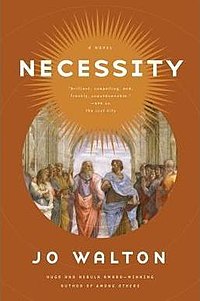
Necessity
by Jo Walton
In The Just City a city was created by the time-traveling goddess Athena on the island of Thera prior to its Iron Age volcanic destruction. It was then populated by philosophers and children from all ages of human history and organized on the principles of Plato's Republic, which turned out not to work so well in practice. In The Philosopher Kings the single original city had split into a dozen: five feuding ones on Thera and another eight on other islands where the inhabitants turned out to be preaching Christianity to Iron Age Greeks. In large part because of the anachronistic introduction of Christianity, all of the cities were relocated by Zeus to an uninhabited far-off planet in the 26th century, which the cities' inhabitants promptly named Plato.
Necessity begins forty years after these events, on the day the mortal form of the god Apollo, who had chosen to live as a human in the original city, finally dies, and he takes up his divine powers again. That same day also sees the first contact between Plato and wider humanity, as a human spaceship appears in orbit and opens communications. Apollo, however, is more concerned with the disappearance of his sister Athene, who, as it turns out, has gone into the Chaos which exists before and after time, in search of knowledge. The rescue of the wayward goddess involves a great deal of intrigue, time travel, and even alien gods. Walton revisits familiar characters from her previous books (both Giovanni Pico della Mirandola and Socrates make an appearance), introduces some new ones and ties up loose ends.